Advertising costs keep rising, and competition is getting tougher, where every click matters the most. If you’re investing in PPC, the real question is whether you actually getting a return on what you are spending?
With the fast-paced and ever-changing PPC trends, it’s sometimes very natural to feel overwhelmed about what will truly work. So, here is a guide that breaks through the noise and highlights latest PPC trends that will help you spend smarter, and drive measurable results in 2026 and beyond.
Must-Know PPC Trends for Every Digital Marketer
PPC in 2026 isn’t only about its latest features, rather it’s all about understanding what are the changes that are happening while staying in control as platforms evolve. From automation to data quality, today’s PPC trends directly affect how your campaigns perform and how you will spend on the budget.
This breakdown focuses on the PPC shifts that matter the most, including what’s driving them, what are the impacts, and how you can adapt strategically without sacrificing visibility, and the integrity of your performance data.
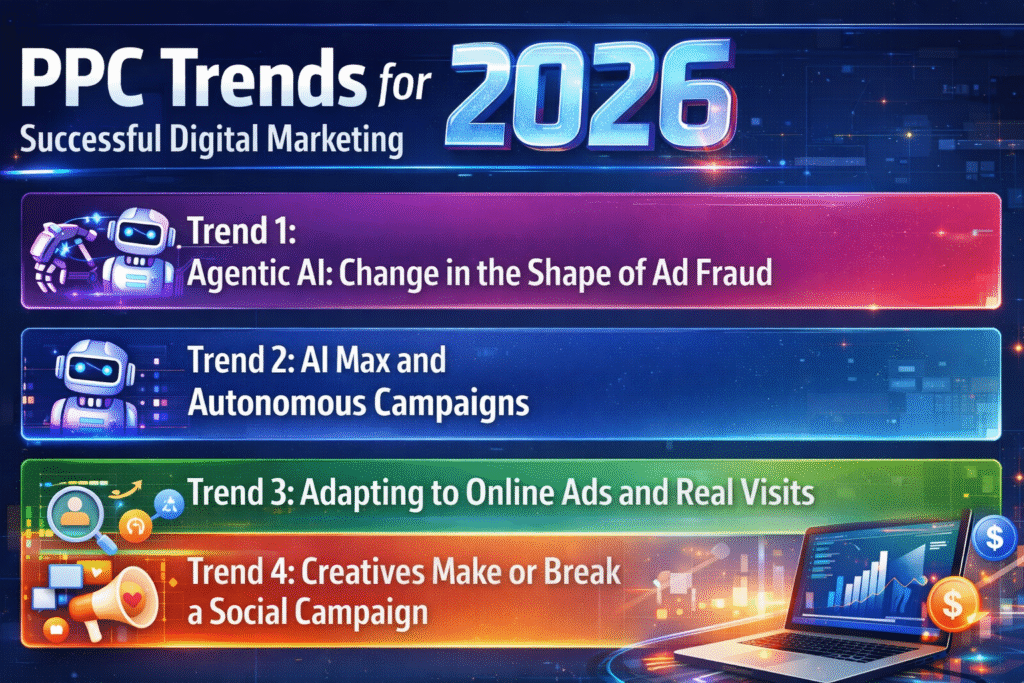
Trend 1: Agentic AI: Change in the Shape of Ad Fraud
As AI adoption accelerates, click fraud is evolving nowadays. The threat in 2026 isn’t low-quality bot traffic—it’s intelligent, self-directed AI that can understand, and copy human behavior across the entire ad journey. These agentic AI systems can easily browse, interact, and even trigger conversions in ways that will look authentic. This will further create a high risk for PPC teams that might restrict them from proper budgets, performance data, as well as optimization signals.
A: How it can Affect PPC Performance?
Sometimes, everything looks fine. Conversions are coming in, lead volume is up. But underneath, PPC performance is quietly breaking down. This happens when fake conversions enter your account, they corrupt the learning process. Platforms like Performance Max start optimizing toward synthetic behavior, that reinforces a loop where automated systems will attract more bots instead of real buyers. As a result, sales team will then inherit the damage: leading to look trustworthy, respond intelligently, and never turn into conversations or revenue. The will result in dangerous false confidence, leading to erosion of real performance.
B: How PPC Teams can Solve this Issues?
Winning in 2026 requires more than just basic blocking system. IP exclusions alone cannot always stop sophisticated, AI-driven traffic. Therefore, detection must focus on behavior patterns Also, invalid traffic must be filtered out before it reaches ad platforms, ensuring bidding algorithms learn from genuine human intent. Finally, PPC teams should be able to audit lead quality. When lead numbers will rise but sales stall, it will be the clearest signal that automation is optimizing for the wrong outcomes.
Trend 2: AI Max and Autonomous Campaigns
Performance Max has crossed a threshold. What began as assisted automation now seems to be a self-driving advertising. With AI Max-style capabilities, Google controls creative assembly, channel distribution, audience targeting, as well as bidding logic with minimum human intervention.
Campaigns can activate across YouTube, Discover, and even in Gmail, often leading to faster conversions. To be honest, automated systems don’t judge quality the way we humans do. They will prioritize the quickest possible ways of success, leading towards low-quality impressions, accidental engagement, or an environment that can dilute brand equity.
A: What it Means for PPC teams?
1: Reduced visibility: While exclusions still exist, they will operate more like corrective measures rather than proactive controls, therefore making oversight slower but more reactive.
2: Increased risk in brand safety: Without any strong boundaries, high-value brands might end up funding low-quality sites which are designed with an aim to capture clicks.
3: Difficult to achieve performance: Achieving meaningful conversions might becomes significantly harder.
B: Ways to Control It?
1: Shape the inputs, not the bids: Focus on high-quality conversion signals, accurate values, and outcomes which are tied to real business impact.
2: Treat exclusions the right manner: Regular placement reviews, and account-level protections are an integral part to keep automation on track.
3: Expand your creative depth: The right kind of video, images, and messaging tools will hit volume goals.
Automation isn’t the problem but definitely overlooking issues is. In 2026, high-performing PPC teams will prefer using AI to scale their reach of making their ads appear the right way.
Trend 3: Adapting to Online Ads and Real Visits
In 2026, PPC is influencing real-world movement. Mobile advertising has reached a point where campaigns guide people to physical locations by merging digital intent with offline behavior. Google’s integration of Waze into Performance Max campaigns built around store objectives has streamlined this shift in the most accurate manner. What once was required separately, it is now handled within a single automated system. Ads can surface directly inside navigation apps, activated by a user’s route, as well as proximity.
A: How This Affects Advertisers?
1: Reaching out to users’ decision: These ads will appear when users are traveling, making them highly receptive to nearby options.
2: Offline outcomes is related to online spend: Store visits, and in-person traffic are now believed to be central performance signals, and not just supporting data.
B: How to use it in the right manner?
- Maintain a precise Google Business Profile
- Activate store-driven PMax campaigns
- Validate real-world engagement
Trend 4: Creatives Make or Break a Social Campaign
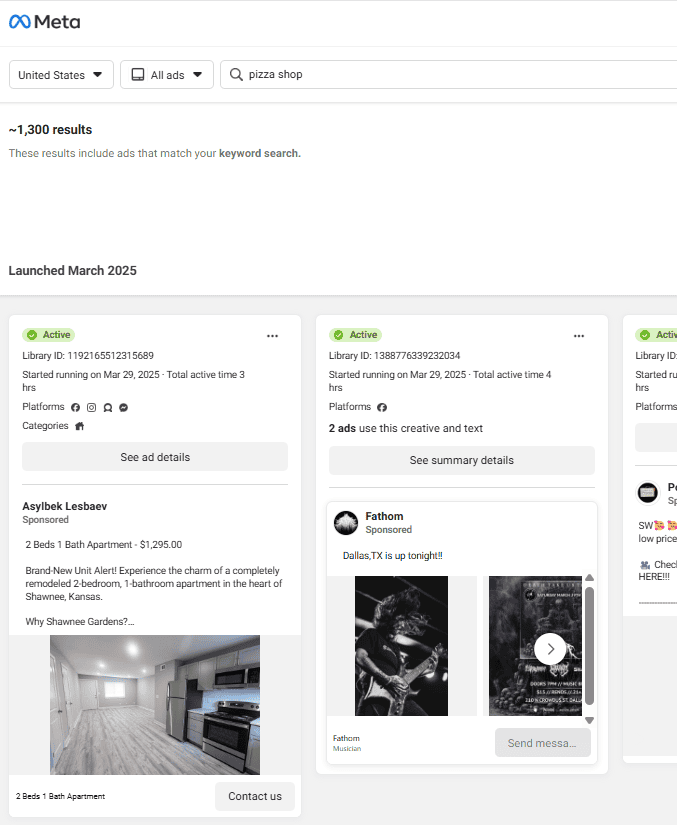
On social platforms like Meta and LinkedIn, your creativity will do the heavy lifting. Visuals, copy, and messaging will gain attention in a crowded feed. High-performing brands treat creativity as a core performance driver. Effective social ads are what your audience responds to. Tools like the Meta Ad Library make this easier by encouraging a transparent view into how other brands position their messaging, and structure their visuals. So, when used correctly, it becomes a roadmap rather than a shortcut.
When creative is informed by data and market awareness, it stops being decoration and starts driving measurable results.
Concluding Thought: In 2026, effective marketing requires fluency in both human behavior and machine logic. Your campaigns should be able to resonate with real audiences to deliver clean, and structured signals that automated systems can accurately interpret. Well, a competitive advantage now lies in knowing where AI should be allowed to scale and where human oversight must intervene to ensure a good performance.