
Marketers are impatient, as they are always looking for faster results, which often distracts them from fresh tactics. But, this is not a proper approach, so sticking to a well-defined strategy will be highly beneficial.
To build a highly effective digital marketing strategy that engages with targeted audiences and boosts your brand, you need to understand its key elements. Let us see how to create a winning digital marketing strategy for your future business.
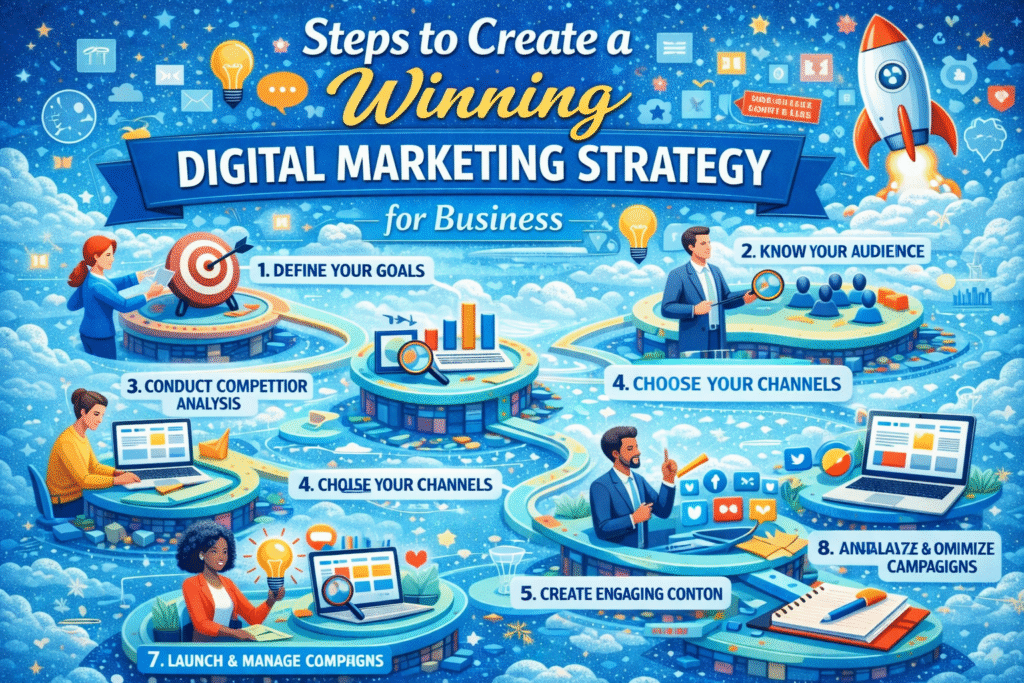
Steps to Create a Winning Digital Marketing Strategy for Business
Creating a proper and winning digital marketing strategy for your future-oriented business can be a challenging task. To make it easier, follow a few steps that will take you through everything you need to know about it.
Step 1: Set “Smart Goals”
To begin your digital marketing strategy, it not only begins with channels but, you must have a clear mindset as well as a defined answer to what you really want to achieve. Your answers should not always revolve around generating more traffic, or improving sales, rather you must be capable of using SMART GOALS. When you are focused on applying SMART GOALS, it will help you transform your wishes into complete concrete, and actionable targets. But make sure it is purposeful that can be measured well. Have you ever wondered what SMART GOALS stands for?
Here’s what “Smart Goals” stands for:
- S – Specific: You must set up a goal that is clear as well as unambiguous.
- M – Measurable: You must know how to track the progress to achieve success.
- A – Achievable: Are your marketing goals realistic based on budget, team, and time?
- R – Relevant: Have you checked whether marketing goals are aligned with your business objectives at a larger scale?
- T – Time-Bound: Are your goals meeting a deadline that will help you measure a clear timeframe for success?
Step 2: Who are Your Target Audiences?
Do remember that when your marketing strategy is developed by you, and is trying to target everyone, keep in mind, it will never resonate with anyone. This is because many businesses make a big mistake of targeting vague audiences like “students” or “working professionals, which are not appropriate. Well, if you want to create a marketing strategy that will truly connect you well, always try to know what you are exactly talking about, and to whom. For this, you must know who your audience is. This is one of the best as well as an effective marketing strategies. You must keep in mind major things that are given below:
- Demographics: Know the initial sketch of your targeted audience like “age”, “location”, “their job title”, “which industry they belong to”.
- Psychographics: This will make you question “Why” that will motivate you to know your business values, and goals.
- Pain Points: This is in fact the most crucial part for creating a strong, and future-oriented marketing strategy. Make sure that your services should have a concrete solution to every problem. A few common problems on which you must focus are “your website gets traffic but there are no leads generated”. Secondly, you must “have your digital skills updated”.
Step 3: Competitor Analysis is Must
A competitor analysis is not always about copying what they are doing rather, you must know where are the gaps, understanding their weaknesses, and then, you should be capable enough to figure out how to make yourself position as a better choice in the market. You must know the ‘Strengths”, “Weaknesses”, ‘Opportunities’, and even “Threats”. Knowing all these will help you map the entire competitive landscape accurately.
Step 4: Choose an Appropriate Digital Marketing Channel
Well, the most common mistake is when you have a thought process that you want everything at once. This should not be your goal rather, you need to think where your audiences are spending their time. This will be based on your goals, budget, and even audience that will help you determine your unique digital marketing strategy. Here are the primary channels that you must consider when creating a successful digital marketing strategy for your business:
- Search Engine Optimization
- Content Marketing
- Social Media Marketing
- Paid Advertising
- Email Marketing
- Influencer Marketing
- Digital PR
Step 5: Know Your Marketing Budget
Another brilliant way to create a future-oriented digital marketing strategy is all about knowing your budget that will help turn your plan into an action. Knowing the budget is a fuel to your digital marketing engine, especially when you know how to allocate it properly, and smartly. So, how to know, and set your marketing budget? Here are a few best ways to get it done:
- You must try to dedicate a fixed percentage of your projected revenue to marketing.
- Rather than starting with a random number, consider having SMART goals.
- Try to know what your key competitors are spending on their marketing strategies.
Step 6: Define Your KPIs (Key Performance Indicators)
For creating a better, and future-oriented digital marketing strategy, you must know what’s working and what’s not. When you know this, it will help you stop splurging money unnecessarily by doubling down on what’s successful. Key KPIs for Digital Marketing Channel:
Overall Website / Business KPIs
- Customer Acquisition Cost (CAC): It defines how much it cost to get a new paying customer. You can calculate this as (Total Marketing Spend / New Customers).
- Customer Lifetime Value (CLV): Total revenue you can expect from a customer. Make sure you have a CLV higher than CAC.
- Overall Conversion Rate: What is the percentage of visitors who are visiting your website.
SEO KPIs
- Organic Traffic: Keep a check on the number of visitors visiting your web site than non-paid ones.
- Keyword Rankings: Where is your website ranking for your top 10 targeted keywords?
- Organic Conversion Rate: Keep a check on the percentage of visitors from organic search which are converted into leads.
Content Marketing KPIs
- Traffic: Percentage of website visitors who are watching your content?
- Engagement Rate: Are you able to engage genuine readers on your website?
- Leads: Percentage of people who have downloaded your how-to-guides after reading blog posts?
- Content Quality: Is your content high-quality enough to attract genuine readers?
Social Media Marketing KPIs
- Engagement Rate: This includes Likes + Comments + Shares / Total Followers.
- Click-Through Rate (CTR): How many readers are there who are reading your posts, are clicking the link to visit your website?
Paid Advertising KPIs:
- Cost Per Click (CPC): How much you have to pay for a click?
- Click-Through Rate (CTR): The percentage of people who see your ads are clicking on it.
- Cost Per Lead / Cost Per Acquisition: What is the cost to get a new lead from your ads?
Step 7: Execute to Monitor Campaigns
This is the most vital step when planning to create the best digital marketing strategy for your business, where yours will move from a written document to a real world. Here are a few things for you to consider:
- Use a content calendar to organize your execution
- Use project management to stay on track
- Monitor your campaigns in real-time
Step 8: Analyze, Report, and Optimize
The market will change, your competitors too will adapt, and of course your targeted audience’s behavior will start evolving. So, your marketing strategy must also adapt to changes. To create the best digital marketing strategy, you must analyse things, and optimize it well.
1. Analyze: Your question should be “Why?”
Analyzing is the best kind of detective work in digital marketing strategy that helps you dig into the questions of “why” behind the “what.”
2. Report: Talk about Your Findings
Your analysis will be useful only when you know how to communicate your findings to the right people appropriately. It is essential for you to tailor your report to your targeted audiences.
3. Optimize: It All about Acting Right
Optimization is all about acting the right way to make smart changes for your digital marketing strategy.
Bottomline
Creating an effective digital marketing strategy for your business is essential to make a significant impact in the digital world. So, by setting up clear goals, having a good, and sound understanding of your audiences, knowing how to select the right channel, while optimizing your marketing approach, will help you lay a strong foundation for a successful digital presence.